Another three years of work, distilled to ten pages. This is a significant departure from my previous research topic on wastewater treatment, but in terms of lab work, it was equally exciting, if not more.
This is also a good example of how exploring ideas beyond what is written in a project proposal can lead to better outcomes than sticking to the plan (if the stars align…)
As always, glad to have published this with Open Access for everyone to read for free. Many thanks to my co-authors and I hope the readers find it useful and/or interesting.
Periodic and Statistically Distributed Surface Texturing of Surface-Enhanced Raman Spectroscopy (SERS) Sensors with Spatially Selective Signal Mapping
Advanced Physics Research (2025): e00124
DOI: 10.1002/apxr.202500124 (read online)
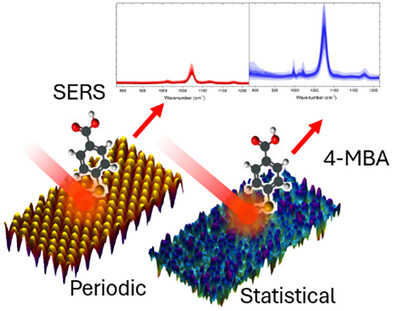
Abstract
Surface-enhanced Raman spectroscopy (SERS) is a highly sensitive and noninvasive molecular fingerprinting technique already making an impact in fields such as medical diagnosis and environmental monitoring. However, challenges persist in the fabrication of SERS substrates, which delays the adoption of SERS as a standard analytical tool.
Here, we experimentally demonstrate and compare two methods for achieving reproducible SERS substrates on a 150 mm wafer scale. In the first approach, we use nanoimprint lithography (NIL) to create highly periodic structures with subwavelength dimensions (< 300 nm). These periodic structures offer high signal uniformity, with a spatial variation of just 7.7% over a 20×20 µm area.
In the second approach, we use a maskless reactive ion etching (RIE) process to create statistically distributed spikes in silicon wafers. Compared to the periodic structures, the statistical structures offer five times greater signal enhancement and twice the signal-to-background ratio at the cost of increased spatial variation.
Both substrate types perform similarly or better than commercially available SERS substrates. In addition, we demonstrate spatially selective Raman mapping via microarray templating by photolithography, with potential for multimodal detection of analytes or use in quality control.
Full author list: Desislava Daskalova, Mustafa S. Özyurt, Holger Lerch, Ulrich Plachetka, Max C. Lemme.

2026 update: as last time, I created a cover image in Blender. I am happy to share that the journal selected it as the cover for their March 2026 issue. The caption is Order vs. Disorder in Surface Raman Spectroscopy. You can see the two substrate types, organic molecules on their surface (brought by the droplets coming out of the pipettes), the red laser probing the Raman signal, and the AFM tip scanning the topography. Lastly, the overlap of squares with data alludes to the multimodal sensing demonstration.